
How we redesigned the RO filter renewal journey across app, WhatsApp, and IVRs
moving conversion from 30% to 80% and contributing ₹XX Cr to Native's revenue
✦
AI Image generations


Role
Sole Product Designer
UX architecture, interaction design, visual design, motion direction, copy, design system
Team
1 Senior Product Manager
Duration
2 Months
November 2025 - January 2026
Outcome
30% → 80% D90 Conversion
November 2025 - January 2026
Urban Company's Native ROs water purifiers are priced at ₹12,000–15,000 with a two-year unconditional warranty; no filter changes, no repairs, nothing. That warranty is the entire selling point. It's what makes Native different from every other RO brand in India.
At exactly two years, the filters expire. Microbial growth starts on the filter surface. The RO stops adding minerals. The water quality degrades even if it still tastes fine. The customer now needs to buy a ₹4,999 Native Refresh Kit to reset the machine for the next two years.
Before this project, roughly 70% of customers were falling off that cliff silently. They weren't angry. They weren't churning loudly. They just... didn't renew. The existing experience was a basic warning inside the RO companion app a banner flagging filter expiry with some copy about contaminants paired with sparse WhatsApp messages that weren't converting. Renewal was sitting at around 30%.
The problem wasn't the product. It was that we weren't telling the right story at the right time.
Old flow vs New flow
Previous data
Before designing anything, we needed to understand why people weren't renewing. We already had some signal from the existing journey data. We supplemented it with user calls.
The data told us where drop-off was happening. Awareness was reaching ~75% of users — most people knew about the expiry. But consideration to purchase was only converting at 44% of that aware base. The problem wasn't reach. The calls confirmed it. We spoke to ~40 users who had expired filters and hadn't renewed. Three personas emerged:
The first was the largest group: people who knew expiry was coming or had already happened, but felt no urgency. The water tasted fine. The app's monthly TDS reports showed healthy ranges. When we asked why they hadn't renewed, the answer was consistent; "the water seems okay." What they didn't know was that TDS is not the only indicator of water quality. Microbial growth and filter degradation happen below the threshold of taste.
The second group was delaying, not refusing; busy, out of town, planning to do it next month. This group just needed a better reason to act now rather than later.
The third group had either sold the RO, moved houses, or no longer used it. These were genuinely lost no messaging would convert them, and targeting them was wasted spend.
One verbatim that shaped the entire messaging strategy: "PX told me some filter life is left so I didn't feel urgency." That sentence told us everything. We had been leading with expiry dates and filter warnings. We needed to lead with what was actually happening inside the machine; make the invisible risk visible and specific.
The lifecycle system
The core design decision of this project happened before we touched any UI or app experience.
We mapped the customer from D-30 to D+90 and asked: what does this person know, believe, and feel at each point and what do they need to hear to move forward?
The answer was different at every stage. Which meant the message had to be different at every stage. We weren't designing a notification. We were designing a four-month conversation.

Lifecycle diagram
The principle governing all four phases: lead with the problem, then give the solution.
Never pitch the kit before explaining why they need it.
App experience
The app was the owned conversion surface. Every other channel; WhatsApp, IVR, SMS was driving traffic back here so it had to be solid.


User journey
All the Whatsapp communications, SMS, app push notifications & IVR calls used to direct the user on this explainer page so it had to lead a narrative & connect the story of why the user should renew their filters.
Explainer page:
App experience
The app was the owned conversion surface. Every other channel; WhatsApp, IVR, SMS was driving traffic back here so it had to be solid.
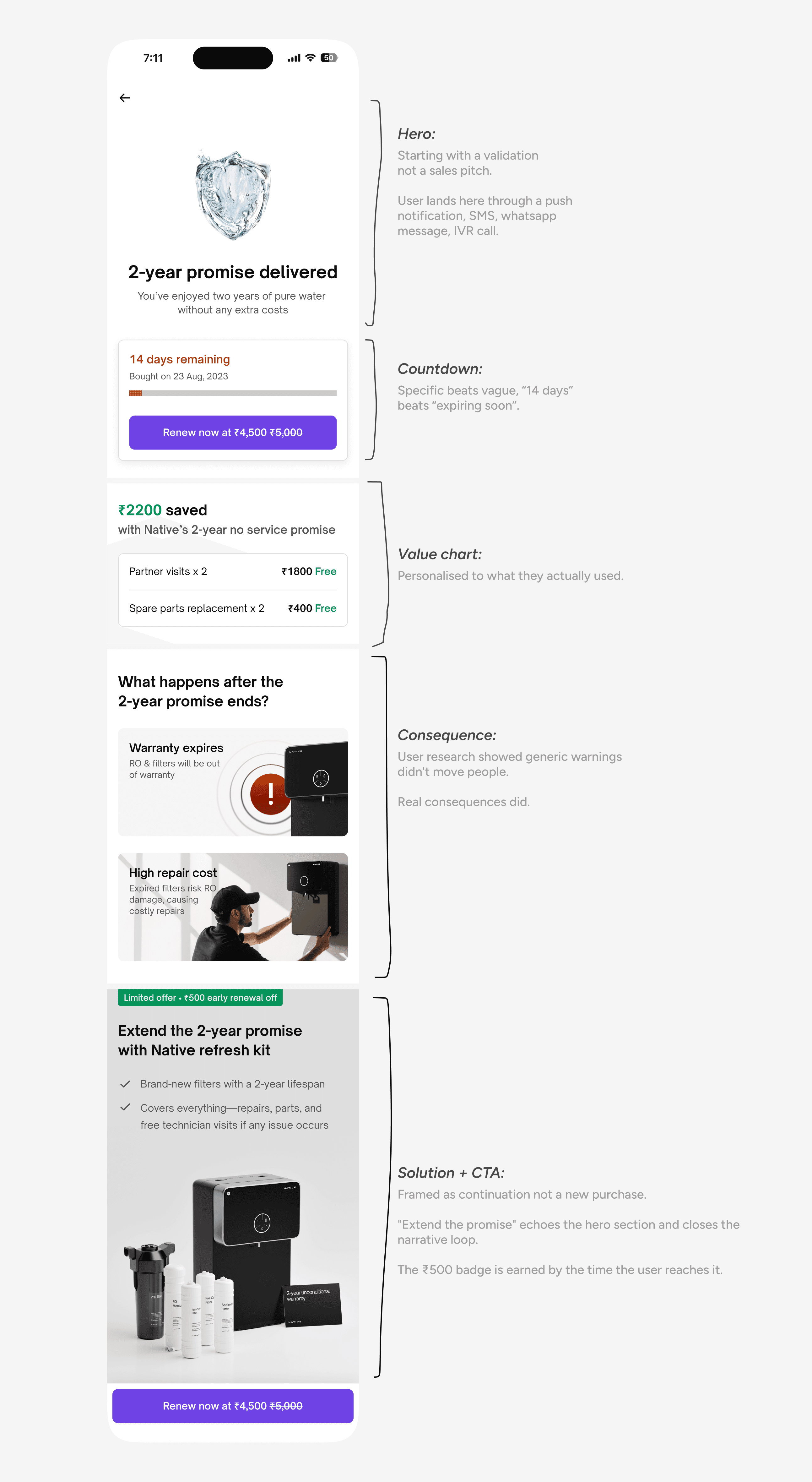
Explainer page breakdown

Push notifications
Whatsapp & AI generated images
WhatsApp was our highest-reach channel outside the app; utility messages hit 77% delivery and 43% read rate versus 26% delivery on marketing messages. If we could make someone stop scrolling on WhatsApp, we had a real chance of converting them.
Text alone wasn't doing it. We needed images that made the consequence of expired filters visceral and specific; something a customer would look at and feel.
Image generation workflows included; Krea, ChatGPT & Gemini.


Rejected iterations
WhatsApp was our highest-reach channel outside the app; utility messages hit 77% delivery and 43% read rate versus 26% delivery on marketing messages. If we could make someone stop scrolling on WhatsApp, we had a real chance of converting them.
Text alone wasn't doing it. We needed images that made the consequence of expired filters visceral and specific; something a customer would look at and feel.
Image generation workflows included; Krea, ChatGPT & Gemini.

Screenshot of Krea's gallery to polish one creative

One of the creative image - where we tried to use the analogy of a kitchen sponge to the filter for the D+30 whatsapp communication message.

Whatsapp message explaining the analogy
The outcome
Renewal rates across mature cohorts moved from a baseline of approximately 30% to 75–85% depending on cohort, with the February 2026 cohort projecting at 85% at full maturity.
To put that in context: the June 2025 cohort had 75 eligible users. Six months later, the January 2026 cohort had 2,230. The system was built to scale as the user base grew; and it did, without the renewal rate degrading.
All these efforts across all the touchpoints contributed approximately ₹XX Cr in filter kit revenue, representing X% of Native's category GMV in the period.
What I learned
The biggest unlock on this project wasn't a design decision. It was a communication one. I learned how segmenting users based on their RO lifecycle & targeting differently at each point of the journey helped us.
What moved the needle in the D+30 to D+60 window; the hardest segment to convert. Users whose water tasted fine had no frame of reference for what expired filters actually looked like. Abstract health warnings weren't working.
So we leaned into analogy and image. AI-generated visuals of worn filter internals, microbial growth, the physical reality of what two years does to a membrane. Just specific enough to make the risk feel real instead of hypothetical.
Learned how crafting copy, whatsapp messages, graphic design & paying attention to the invisble things pays out in the end.